Indian Air Force Recruitment 2026
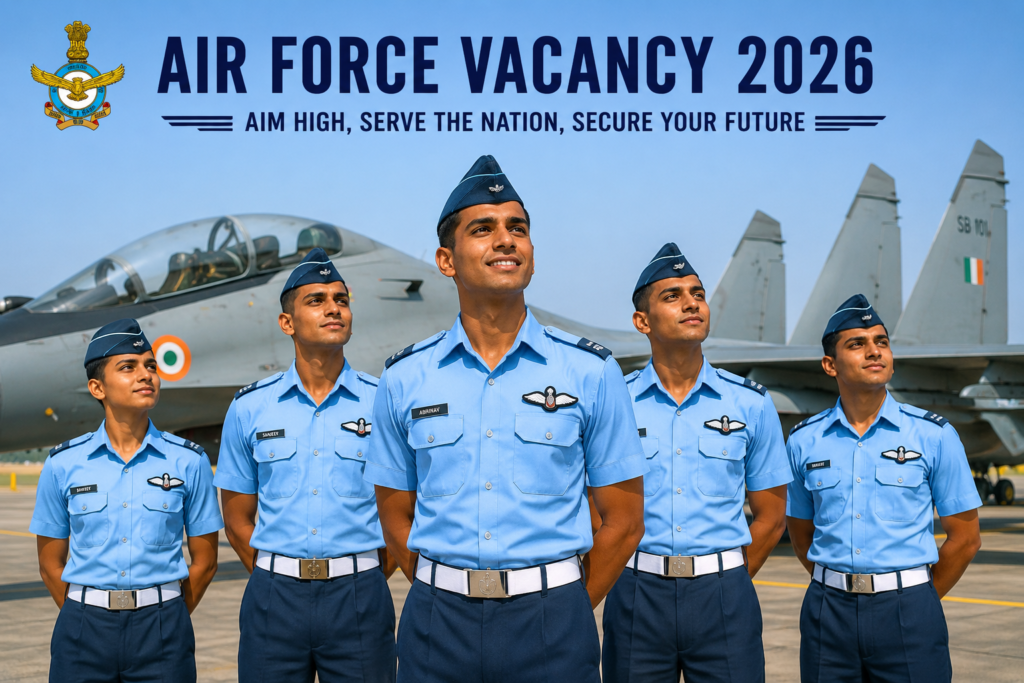
Introduction
Joining the Indian Air Force (IAF) is a prestigious and competitive endeavour. Every year, thousands of young Indians aim to “touch the sky with glory” by qualifying for IAF commissions or airmen posts. The year 2026 brings new recruitment drives – from permanent Flying/Technical Branch officers via AFCAT/CDS/NDA to the Agnipath scheme for airmen (“Agniveervayu”), as well as civilian posts. Clear, current information is crucial: eligibility rules, age limits, exam dates, and preparation plans all determine success. This guide matters because it compiles all 2026 IAF recruitment details in one place, from official notifications to salary and training. Whether you aim to be a flying officer or an Agniveervayu airman, reading this will save time and clarify the path ahead.
An IAF fighter jet in flight – symbolising recruitment and opportunity in the Air Force.
Official Notifications and Vacancies 2026
The IAF recruitment cycle for 2026 includes multiple streams: Commissioned Officer entries (Flying, Ground Duty, Medical), Agniveervayu (airmen under Agnipath), and Group-C civilian posts (clerks, technicians). Key official notices:
- AFCAT 01/2026 (UPSC) – The Air Force Common Admission Test for Flying and Ground Duty (Technical and Non-Technical) branches. Online applications were open 17 Nov–14 Dec 2025, with the exam on 31 Jan 2026. This recruits Group ‘A’ Gazetted officers for courses starting Jan 2027. For example, vacancies included 34 Flying Branch PCs (men) and 4 (women), plus dozens of Technical and Non-Tech slots. (Up-to-date details in the official notification.)
- NCC Special Entry – 10% of DSC/AFCAT seats for Flying branch are reserved for NCC Air Wing senior division ‘C’ certificate holders (men). These use the same exams as AFCAT/CDS but have relaxed requirements.
- CDS/AFCAT – Officers can also enter via Combined Defence Services (CDS) exam (conducted by UPSC) or NDA exam. CDS (I/2026, etc) and NDA (I/2026, II/2026) announcements by UPSC will include Air Force seats. (UPSC notifications appear on upsc.gov.in.)
- IAF Agniveer Vayu Intake 02/2026 – Under the Agnipath Scheme, unmarried males and females could apply from 11–31 July 2025. Online exam started from 25 Sep 2025. This fills Agniveervayu (airmen) billets. The official notice (advertisement) was published on agnipathvayu.cdac.in. (Example: “Selection Test for Agniveervayu Intake 02/2026”.)
- Group C Posts (Civilian) – The IAF filled lower-division clerk, typist, driver, and other civilian vacancies via public advertisement. For instance, Employment News (2–8 May 2026) carried Advt. 01/2026 announcing 47 posts (LDC, Hindi Typist, Civilian MT Driver). (Other posts like Airmen Tradesmen/Technician were handled separately, often through Rally or Rally-for-Airmen notifications.)
- Apprentices – Separate notifications (e.g. on indianairforce.nic.in or employment news) invite applications from ITI/12th passed youths for technical apprentices in IAF (usually ~100–150 vacancies).
- Air Force Schools, etc. – Teaching and support staff hires (e.g. for Air Force Schools) are NOT covered here as they are civilian education posts.
In summary, 2026 sees multiple IAF vacancies:
| Entry Type | Mode | Courses | Notifications |
|---|---|---|---|
| Commissioned Officers (PC/SSC) | AFCAT, NDA, CDS, NCC-Spl. | Flying, Ground Duty (Tech/Non-Tech) | AFCAT 01/2026 (UPSC), NDA/CDS by UPSC |
| Agniveervayu (Airmen) | Agnipath Recruitment Rally | Technical (10+2/Diploma) & Non-Tech | Agniveervayu Intake 02/2026 (IAF) |
| Group ‘C’ Civilian (Clerk, etc) | Direct Recruitment Notice | LDC, Typist, Driver, etc. | IAF Civilian Advt. (e.g. EN 2–8 May 2026) |
Eligibility Criteria
Commissioned Officers (AFCAT/CDS/NDA)
- Citizenship: Indian citizens only.
- Age: For Flying Branch (AFCAT/NCC): 20–24 years as on 1 Jan 2027 (DOB 2 Jan 2003 to 1 Jan 2007). (Upper age relaxable to 26 for CPL holders.) For Ground Duty Tech/Non-Tech: 20–26 years as on 1 Jan 2027. NDA age is slightly younger (16½–19½ yrs on exam). Standard age relaxations apply (e.g. +5 yrs for SC/ST, +3 for OBC as per govt. rules).
- Marital Status: Unmarried (no marriage during training).
- Education: Varies by branch:
- Flying Branch: 10+2 with ≥50% in Physics and Maths, and either a 3-year graduate degree (any discipline) with ≥60%, or a 4-year BE/BTech (any branch) with ≥60%, or cleared Sections A/B of IES/IAS.
- Ground Duty (Technical): Engineering degrees/Science grads as specified. For example, Aeronautical Engineer (Electronics) needs 50% in 10+2 (PCM) and a 4-year Engineering degree in EI/EE/EC/CS/IT/AI etc with ≥60%. (Other tech branches similar.)
- Ground Duty (Non-Tech): Weapon Systems (WS) Branch requires 50% in 10+2 (Maths/Physics) + any degree (60%) or BE (60%). Admin & Logistics require graduate (60%). Accounts branch needs BCom/BBA/CA etc (60%). Education branch requires post-grad (50%). Meteorology entry (through Met exam) needs 10+2 with PCM (60%) or related science degree. (Detailed branch-wise lists are in official notifications.)
- Medical & Physical: Must meet IAF medical standards (vision, chest, hearing, etc.). E.g. minimum chest 77cm (expansion 5cm) for men, uncorrected visual acuity standards as per IAF (plus allowances for spectacle use), hearing intact, height & weight proportionate (min. 152 cm height for men and women). Tattoos allowed only in restricted areas. (Full standards in IAF instructions.)
Agniveer Vayu (Airmen under Agnipath)
- Citizenship & Age: Indian citizens; born 2 Jul 2005 to 2 Jan 2009 (i.e. 17½–20½ yrs). (Upp age 21 at enrolment).
- Education: Science stream: Passed 10+2 with 50% each in Maths & Physics, and 50% in English. Non-Science stream: Passed 10+2 (any stream) with 50% and 50% in English. (Three-year diploma with PCM can substitute 10+2 if 50% and 50% English.)
- Marital Status: Unmarried; agree not to marry during 4-year engagement. Women must not become pregnant (pregnancy leads to discharge).
- Medical/Physical: Fit in all respects. Height min 152 cm (147 cm for hill states). Chest, vision, hearing as per standards above. (IAF strictly enforces fitness; see “medical and CSD facilities” note for Agniveer pay but covers general fitness.)
- Other: No permanent body tattoos (allowed only on inner forearm/back-of-hand for non-offensive tribal designs). No drug use, no gender reassignment. Sikh candidates may keep beard/mustache per religious practice.
Civilian Group C (Clerks, Drivers, etc.)
- Age: Typically 18–25 years (exact limits vary by post; some relaxations as per govt).
- Education: E.g. LDC: 12th pass + typing (35 WPM Eng/30 WPM Hindi). Typist: 10+2 + typing. Driver: 10+2 + HTV license, etc.
- Other: Indian citizen, satisfy medical/physical (particularly for driver’s license, Vision etc). Reservations apply (SC/ST/OBC/PwD quotas by rules). (See official IAF advertisement for details.)
Application Process (Step-by-Step)
- Read Official Notification: Check IAF/UPSC websites and Employment News for notifications (AFCAT, Agniveer, etc). Verify eligibility and vacancy details.
- Register Online: Most entries use online application. For AFCAT, apply on afcat.cdac.in between 17 Nov–14 Dec 2025. For Agniveer, register on agnipathvayu.cdac.in from 11–31 July 2025. For Group-C, apply as per Employment News notice (usually offline or through government portal).
- Fill Application: Enter personal, academic, and contact info. Upload required documents/scans (photo, signature, IDs, caste/PwD certificates if applicable). Pay fee online. (E.g. AFCAT fee is ~₹250 for General).
- Print and Save: After submission, download/print your confirmation form and payment receipt. Candidates should keep multiple copies for records.
- Admit Card: Download admit card from official site when released (typically 1–2 weeks before exam). Check details (dates, centers).
- Document Checklist for Exam/Interview: Bring original + copies of key certificates at each stage (educational mark sheets, DOB, caste/PwD, NDA admit card if any, photo ID, etc). Agniveer and AFCAT candidates bring similar documents (see official “Document List” by CASB).
Before each stage, candidates should check the official portals: AFCAT (afcat.cdac.in), Agniveervayu (agnipathvayu.cdac.in), UPSC (upsc.gov.in) for any updates or corrections.
Important Dates and Timeline
A summary of key 2025–26 dates:
| Event | Date |
|---|---|
| AFCAT 01/2026 (Officers) | Online apply: 17 Nov – 14 Dec 2025<br>Exam: 31 Jan 2026 |
| Agniveervayu Intake 02/2026 | Online apply: 11 – 31 Jul 2025<br>Written Exam: from 25 Sep 2025 |
| Agniveer Phase-II (PFT/Rally) | Jan 2026 (likely January exam rally) |
| Group-C (LDC/Typist) | Apply: 2 May – 1 Jun 2026<br>Exam: ~June 2026 (TBD) |
| NDA 1/2026 (Officers) | Apply: Jan–Feb 2026 (est.)<br>Exam: 21 Apr 2026 |
| CDS 1/2026 (Officers) | Apply: Jan 2026<br>Exam: 21 Feb 2026 |
| Courses Start | AFLD, WAC courses start late 2026/early 2027 |
2025-08-012025-09-012025-10-012025-11-012025-12-012026-01-012026-02-012026-03-012026-04-012026-05-012026-06-01Apply OnlineWritten Test (Phase-I)Apply OnlineWritten ExamPhase-II Rally/PFTSSB/AFSB TestingApply OnlineWritten Exam/SelectionCommissioned (AFCAT 01/2026)Agniveer Vayu Intake 02/2026IAF Civilian Group-C (LDC/Typist)IAF Recruitment 2026 TimelineShow code
[Table: Schedule of IAF recruitment events (dates approximate).]
Exam Pattern and Syllabus
AFCAT (Officers)
- Mode: Online (Computer-Based Test).
- Sections: General Awareness, Verbal Ability, Numerical Ability, Reasoning & Military Aptitude (cohort). Each section ~ 50 questions (total 100).
- Marking: +3 for correct, -1 for wrong.
- Duration: 2 hours.
- Syllabus:
- General Awareness: Current events, history, geography, defense, static GK, etc.
- Verbal Ability: English usage, comprehension, synonyms/antonyms, etc.
- Numerical Ability: Arithmetic, algebra, geometry, statistics.
- Reasoning & Military Aptitude: Verbal/non-verbal reasoning, spatial ability, basic military knowledge.
(Exact details in official syllabus on afcat website.)
Candidates clearing AFCAT are called for a 5-day AFSB interview (psych tests, group tasks, interview), then medical check.
Agniveervayu (Airmen)
- Phase-I (Written): Objective MCQs, CBSE Class 10+2 level.
- Streams: “Science Subjects” (PCM+English) or “Other than Science” (English+Reasoning+General Awareness).
- Example pattern: Science stream gets Physics, Maths, English papers (60 min each); Non-Science gets English & Reasoning/GA (45 min). Candidates opting both streams have combined paper (~85 min total).
- Marking: +1 for right, -0.25 for wrong. Final merit is normalized score.
- Syllabus:
- Physics: 10+2 CBSE level topics (Laws of Motion, Thermodynamics, Electricity, Optics, Modern Physics, etc).
- Mathematics: 10+2 level (Trigonometry, Algebra, Calculus, Probability, Vectors, etc).
- English: Reading comprehension, vocabulary, grammar (tenses, prepositions, voice/narration, sentence improvement).
- Reasoning: Verbal/non-verbal analogies, coding, series, blood relations, directions, etc.
- General Awareness: Current affairs (6–8 months), basic history, geography, defense, sports, science.
- Phase-II (Physical & Adaptability):
- Physical Fitness Test (PFT): 1.6 km run, pull-ups (for men), push-ups/sit-ups (for women), squat thrusts. (Timing standards vary by gender.)
- Adaptability Tests: Simple verbal, non-verbal tests (quiz-like) to gauge alertness/resilience.
- Document Verification of certificates.
- Phase-III (Medical): As per IAF standards.
Preparation Tip: Use NCERT 11–12 science textbooks and solve sample questions. See GovtPoint’s breakdown for topics. Regular mock tests and daily current affairs help.
Selection Process
- AFCAT/CDS/NDA (Officers): After the written exam, shortlisted candidates undergo the Air Force Selection Board (AFSB) interview. This includes Stage-I (Officer Intelligence Rating, Picture Perception), and Stage-II (5 days: Group Testing Officers tasks, Psychology, Personal Interview). Finally, medically fit candidates who clear SSB are “recommended for commission”.
- Agniveer Vayu: Merit list is prepared from Phase-I written scores. Those called undergo the PFT rally (usually held at various centres), then adaptability tests and document check. Successful candidates then face a medical exam. Final enrollment (short service) is on merit and medical fitness.
- Group C Clerks/Drivers: Typically Written Exam → Skill/Type Test (for LDC, Typist, Driver’s license test) → Document Verification → Medical. For LDC/Typist, qualifying typing is required.
In all cases, ensure (i) actual fitness (no last-minute refusals); (ii) stay updated via the official portal (e.g. AFCAT or CASB websites). The entire selection timeline can span 3–6 months from notification to final joining (often one training batch per year).
Pay Scales, Allowances and Perks
Officers
Officers follow the 7th CPC pay matrix. For example:
| Rank | Pay Level | Basic Pay Range (₹) |
|---|---|---|
| Flying Officer (post-commission) | Level 10 | 56,100 – 1,77,500 |
| Squadron Leader | Level 11 | 69,400 – 2,07,200 |
| Wing Commander | Level 12A | 1,21,200 – 2,12,400 |
Additionally, officers receive:
- Military Service Pay (MSP): ₹15,500/month (as part of pay).
- Flying/Technical Allowance: e.g. Flying Officer pilots get ₹11,250/month flying allowance (Squadron Leaders/Wg Commanders get more). Technical officers get a technical stipend during training (₹2,500–3,750).
- Dearness Allowance (DA): % of pay, linked to inflation (currently ~28% for CAFs, ~17% for MCP and Group C).
- House Rent Allowance (HRA): 10%-30% of pay depending on city class.
- Transport Allowance (TA): ₹3,200+DA in major cities (₹1,600 in others).
- Other Allowances: Field Area/High Altitude/Pilot kits etc as applicable; Risk and hardship allowances for deployments.
Officers get extensive perks: furnished accommodation/housing loan, CSD shops, free medical for self & family, leave travel concession, government pensions on retirement, etc. (See Unacademy for benefits.)
Agniveervayu (Airmen)
- Pay Package: Fixed ₹30,000/month initially, with annual increments (~₹2,500/year).
- Allowances: Risk and hardship allowances (for specific duty), and dress/kit allowances. No pension.
- Perks: Ration, clothing, accommodation, LTC (leave travel concession) as per IAF norms. Free medical facility for self while in service.
- Seva Nidhi Package: On completion of 4-year term, the one-time gratuity (Seva Nidhi) is given – approx. ₹10.04 lakh (including government contribution). That is equivalent to 70% of total pay drawn, returned as lump sum. (No pension or ESM status.)
Civilian (Clerical/Technical)
Group C staff get pay in Level-2/3/5 of 7th CPC (approx ₹19,900–63,200 basic for LDC). They receive DA, HRA, TA etc. Apprentices get stipend (~₹7,000–8,000) and allowances.
Pay Comparison Table
| Position | Pay Level | Basic Pay Range (₹) |
|---|---|---|
| Flying Officer (IAF Comm.) | Level 10 | 56,100 – 1,77,500 |
| Agniveervayu (Airman)** | – (fixed) | ~₹30,000/month |
| LDC (IAF Group C Clerk) | Level 2 | 19,900 – 63,200 (entry) |
Note: Agniveer entry pay is a flat package; Group C pay shown per 7th CPC Pay Matrix.
Training and Career Progression
- Officers: Flying and Ground Duty cadets train at the Air Force Academy (AFA) in Dundigal, Hyderabad. Flying cadets undergo 74 weeks of flying training; Tech/Non-tech do 52 weeks. After passing out, Commissioned Officers start as Flying Officer (or equivalent Ground Duty rank) and get promoted roughly: Flying Officer → Flight Lieutenant (after 3 yrs), Squadron Leader (6 yrs), Wing Commander (13 yrs), Group Captain (20 yrs), Air Commodore+. Progress depends on performance and vacancies.
- Agniveervayu: Serve a fixed 4-year term. Outstanding Agniveers (approx. 25% or as decided by IAF) may be enrolled into regular airmen cadre (X or Y group) after passing selection tests during/after service. Others exit after 4 years (with Seva Nidhi). Career beyond 4 years depends on defense policies. Agniveers can re-apply through NDA/AFCAT (max 3 tries) while serving. No pension or long-term career guarantee under current rules.
- Group C: On joining as LDC/Typist, promotions follow civil post hierarchy (LDC→UDC→Steno→Accounts/Clerk roles, etc). Drivers/technicians have separate trade promotions.
IAF offers educational courses (even abroad) and rank progression for all cadres. (For example, Ground Duty technical officers get B.Tech after 2 yrs seniority etc.)
Reservations and Relaxations
IAF follows Government of India rules:
- Age Relaxation: +5 years for SC/ST, +3 years for OBC-NCL (for Commissioned entry) on age limits; similar relaxations for widows/wards etc as per rules. Physically handicapped candidates (as per DoPT categories) get age relax as per extant rules.
- Educational Qualification: Minimum marks relaxations as per category may apply (e.g. passing marks in 10+2, or % requirements can be relaxed for SC/ST in certain branches). Check each notification.
- NCC Quota: 2 seats in each flying branch course are reserved (as 10% of vacancies) for NCC special entry (men) (they need valid ‘C’ certificate).
- Women Candidates: Open to all branches (Flying, Tech, Non-Tech) under short service commission (except NCC entry).
- Ex-Servicemen: Not applicable for AFCAT (PC/SSC), but Group C recruitment has ESM quota (typically 10%).
- Tribal Tattoo Relaxation: Tribal candidates may have permanent tattoos for customs.
All relaxations are listed in the official recruitment notifications (for example, AFCAT Notification Para 6 and 7 covers category relaxations).
Document Checklist
Candidates should keep ready originals and copies of:
- Photo ID proof (Aadhaar/Voter/Passport/PAN/Driving License).
- Educational certificates: mark sheets and passing certificates for 10th, 12th, Diploma/Degree.
- Proof of DOB (10th certificate or school leaving cert).
- Caste certificate (if claiming SC/ST/OBC/PwD benefits). SC/ST in prescribed format, OBC-NCL with non-creamy layer certificate.
- NCC Certificate (for NCC entry).
- NCC Certificate (for NCC entry).
- EWS certificate if claiming EWS.
- Identity proofs for Wards of Battle Casualties, if applicable.
- Two passport-size photos (as per specs).
- ID for SSB/AFSB call (printed admit card).
- For Agniveer: same education/DOB documents, plus photo ID.
Always verify the exact list in the notification (paragraph “Documents required”).
Preparation Tips and Resources
- Understand the Pattern: Study the official syllabus. AFCAT aspirants should practice English, maths, reasoning and general awareness question banks. Agniveer aspirants should revise 10+2 Physics/Maths and general studies.
- Quality Books/Resources: NCERT textbooks (Class 11-12) for fundamentals. Standard guides: Arihant’s AFCAT guide, previous year papers. Online resources: IAF and defense exam coachings (Testbook, Gradeup, etc.). Official UPSC old CDS/NDA papers for practice.
- Mock Tests: Take regular full-length mock tests (both for written exam and for SSB style), to build speed and accuracy. For Agniveer, online mock quizzes for SSC-CGL reasoning and basic physics help (since level is +2). Apps like “Defense Exams – Mock Tests” can be useful.
- Physical Training: Start early PFT practice: running, push-ups, sit-ups. Eg. GovtPoint recommends a 30-day plan. Aim to exceed minimums for confidence.
- Current Affairs: Read monthly current affairs magazines and daily newspapers. Focus on defense news, govt schemes, international events, sports. For AFCAT, politics, economics and science GK is useful.
- SSB Preparation: For officer entry, practice group discussion, interview skills, and personal awareness (know basic history of India, defense). SSB Book by Arihant, online SSB mock interviews help.
- Avoid Fraud: IAF emphasizes selection is fair & on merit only. Beware of touts. Apply only through official channels.
Common Mistakes to Avoid
- Late Registration: Many miss deadlines. Note exact dates (online gates close promptly as per notification).
- Wrong Branch/Choice: Carefully read branch eligibility (e.g. entering wrong stream for Agniveer).
- Incomplete Applications: Missing photo/signature or incorrect documents. Proofread forms before submission.
- Underestimating Medical: Failing due to eyesight, dental, obesity, tattoos. Check fitness norms early. For example, Agniveer candidates with uncorrected vision >±0.50D are not accepted.
- Poor SSB/Interview Prep: Ignoring psychological tests or personal interviews; not practicing speaking clearly or dressing professionally for interview.
- Ignoring Physical Prep: Cramming written prep but neglecting fitness; then failing PFT. Start running and exercise months in advance.
FAQs
- What are the main entry exams for IAF in 2026?
The primary entry routes are AFCAT (for Flying/Ground Duty officers), NDA/CDS (for Flying branch), Agniveer Vayu selection tests (for airmen under Agnipath), and IAF civilian recruitment notices (for clerks, etc.). AFCAT 01/2026 was held Jan 2026. Agniveervayu Intake 02/2026 registration was July 2025. UPSC conducts NDA/CDS twice yearly with IAF vacancies. - What is Agniveervayu and its eligibility?
Agniveervayu is the IAF airmen recruitment under Agnipath Scheme. Unmarried male/female candidates (born Jul 2005–Jan 2009) with 10+2 (non-med) or equivalent with 50% marks can apply. Applicants choose ‘Science’ (Math+Phys+Eng) or ‘Non-Science’ (Eng+Reasoning+GA) exam stream. Selection involves a written test, PFT, adaptability tests, and medical. Monthly pay₹30,000. After 4 yrs, discharge with lump sum (₹10.04 lakh). - What are the age and education requirements for Flying Branch?
For Flying branch via AFCAT/NCC, age is 20–24 (born 2003–2007). Educationally, 10+2 with ≥50% in Physics and Maths and either a 3-year graduate degree (60%+) or a 4-year BE/BTech (60%+). NDA entrants must be 16½–19½ yrs old and 12th pass (PCM). - What is the AFCAT exam pattern and syllabus?
AFCAT has 100 MCQs (3 marks each, –1 negative) on General Awareness, Verbal Ability, Numerical Ability, Reasoning and Military Aptitude. Duration is 2 hours. Topics cover basic grammar and comprehension (English), arithmetic and algebra (Maths), reasoning puzzles, current affairs, and some technical knowledge for Ground Duty Tech. The detailed syllabus is in the official AFCAT notification. - What salary and allowances do IAF officers get?
A newly commissioned Flying Officer has Level-10 pay: basic pay ~₹56,100 (entry) rising to ₹1,77,500 as they advance. They also get MSP ₹15,500, flying allowance (approx ₹11,250/month), DA (~28%), HRA (10–30% of pay), TA, etc. For example, in major metros FO gets ₹3,200+DA TA and 30% HRA. Details are in the 7th CPC pay matrix. The annual package (including allowances) for a Flying Branch FO is roughly ₹8–10 lakhs. - What preparation resources are recommended?
Use official materials like previous year AFCAT papers and NCERT books for basics. Coaching platforms (Unacademy, Testbook) and standard guidebooks help. For Agniveer, study NCERT Class 11–12 Physics/Maths and practice reasoning/GK. Mock tests are vital. Also train physically for PFT. - How to avoid rejection at SSB/medical stage?
Ensure all certificate details (DOB, names, marks) match exactly in application. Be truthful about medical history (concealing issues leads to later disqualification). Start fitness, clear dental, check vision (uncorrected vision beyond standards leads to rejection). For SSB, work on confidence and speaking skills; familiarize with current defense affairs.
Read More blogs–Find Gov Jobs
🔥 Ready to Apply? Live Govt Jobs Available Now:
Don't just read the guide—take action. Check out these top active recruitments.